
Question
Is it shirk to stand for the national anthem or salute the flag?
I am concerned because some phrases in the anthem seem problematic. For example, it says that the nation determines destiny, whereas we believe only God controls destiny. Also, saluting the flag feels like an act of disbelief. Could you please clarify whether these actions are permissible in Islam?
Answer
The question of whether standing for a national anthem or saluting a national flag constitutes shirk (polytheism) arises from a commendable concern for preserving the purity of Islamic monotheism (tawḥīd). In Islamic theology, shirk refers to the act of associating partners with God in His lordship (rubūbiyyah), worship (ʿubūdiyyah), or names and attributes (asmāʾ wa ṣifāt), and it is considered the gravest sin. However, while shirk in its essence is rooted in one’s internal belief and intention—specifically, the attribution of divine qualities to beings other than God—it is important to recognise that certain physical actions, regardless of intention, are themselves prohibited in Islam because of their exclusive association with acts of worship. Full prostration (sujūd) or deep bowing (rukūʿ) to any being other than God falls into this category and is not permitted, even if performed without an explicit belief in the divinity of the one to whom the gesture is made. These actions belong to the ritual language of worship and are thus religiously regulated. In contrast, common gestures such as standing or saluting, when performed in civic or cultural contexts, are not inherently religious and do not constitute acts of worship. Unless these gestures are accompanied by a belief in the divine nature of the person or object being honoured, they do not amount to shirk, though they may be subject to further ethical or prudential evaluation depending on the context.
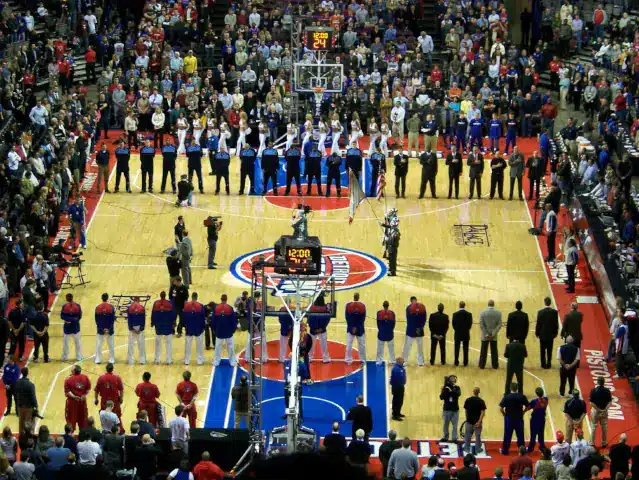
Standing during a national anthem is generally understood as a gesture of civic respect, not as an act of religious reverence. In support of this, a relevant prophetic precedent is found in the well-known ḥadīth in which the Prophet Muhammad (peace be upon him) instructed his companions to stand in honour of Sa’d ibn Muʿādh (ra) by saying,
“Qūmū ilā Sayyidikum” (Stand up for your chief)
Bukhārī 3043; Muslim 1768
This act of standing was not religious worship but a demonstration of respect and recognition for a person of virtue. Imām al-Nawawī, in his commentary on this ḥadīth, explains that this narration evidences the permissibility, and even the recommendation, of standing for dignitaries or people of virtue upon their arrival. He writes,
“This ḥadīth proves that it is recommended to honour people of virtue and to receive them by standing for them when they arrive. The majority of scholars have used this as evidence for the desirability (istiḥbāb) of standing.”
He further clarifies that the kind of standing prohibited in other narrations refers specifically to those who continue standing over a seated person in exaggerated reverence or imitation of servile behaviour. Imam Nawawī concludes,
“Standing for a person of virtue when they arrive is recommended. Several ḥadīths support this, and no clear text prohibiting it has been authentically established,” adding that he composed a detailed treatise on the subject to address misinterpretations surrounding the matter. Therefore, if the Prophet (pbuh) instructed standing for a respectable person, then standing for a national anthem, when done without religious or divine connotation, is even less problematic.
Regarding the content of some national anthems, such as the assertion that “the nation decides our destiny,” this statement, taken literally, would contradict the Islamic belief that only God controls fate. However, if you are referring to the Indian national anthem, then please note that there is some debate about whether expressions such as “Bhārat Bhāgya Vidhātā” refer to the nation or the Maker/Creator/Controller of the Destiny of all Creation, especially India, i.e. the Divine Power. According to the historian Sabyasachi Bhattacharya, Sir Rabindranath Tagore wrote this as “a hymn to his Maker, the guardian of the country’s destiny.”
Similarly, saluting the flag is a civic protocol akin to a symbolic pledge of loyalty or respect. It does not entail any act of worship or divine veneration. In early Islamic practice, the Prophet (peace be upon him) used flags and banners (liwāʾ and rāyah) to symbolise groups and leadership in battles and processions. One example is when he gave the flag to ʿAlī ibn Abī Ṭālib (ra) on the day of Khaybar (Bukhārī 4210). These flags represented Muslim identity and leadership but were not treated as sacred objects of worship. By analogy, the use of modern national flags as symbols of unity and governance does not contradict Islamic principles, provided no religious sanctity is attached to them. As such, saluting the flag is not an act of kufr (disbelief) or shirk unless it is carried out with intentions or beliefs that infringe on tawḥīd.
In conclusion, neither standing for the national anthem nor saluting the national flag is inherently shirk, provided these actions are devoid of religious intent and do not express divine reverence. They are understood within their social and administrative context as expressions of respect and civic identity.
I hope this helps.
Regards,
Mushfiq Sultan
Assistant Fellow, Al-Mawrid